
How to Sell a House During Divorce in NY: 3 Options for Equitable Distribution
Key Takeaways
- New York courts divide marital property fairly, not automatically 50/50, making your chosen sale strategy critical to your financial outcome.
- Holding the house too long increases conflict and risks severe financial issues for both parties, including potential foreclosure if payments lapse.
- The buyout option often fails because the remaining spouse typically can’t qualify for a new mortgage (Cash-Out Refinance) on a single income (DTI Shock).
- Listing with a realtor is slow (3+ months), expensive (5-10% in fees), and requires non-cooperative ex-spouses to agree on everything from repairs to offers.
- Selling to a cash buyer is the fastest answer to “how to sell my house fast during a divorce,” providing a guaranteed “as is” closing in about 14 days.
- If one party refuses to sign, a judge can order this process and assign a referee to sign the property away on their behalf.
Selling a marital home is often the most complex and emotionally draining step of a divorce. In New York, the property is subject to Equitable Distribution which is a legal concept that demands precise financial decisions and timely action. New York courts divide marital assets fairly, not automatically 50/50, so your sale strategy directly affects your net financial outcome. (CFR Title 22, Part 202.16)
The financial burden is widespread. CDC provisional data shows about 672,502 divorces and annulments in the U.S. in 2023, confirming the urgent need for clear exit plans. The true challenge is avoiding the heavy costs associated with delay. When payments lapse, both parties risk a Foreclosure filing and severe credit damage. If you are confused about how to sell my house fast during a divorce, read this guide to explore the three primary court-recognized ways to mitigate this risk.
Option 1: One Spouse Buys Out the Other (The Complex Path)

For some couples, particularly those with children seeking stability in the same school district, one spouse attempts an equity buyout. While emotionally appealing, the financial and legal mechanics of an equity buyout are often the most challenging, and they do not always answer the question of how to sell my house fast during a divorce.
The Hurdles of a Cash-Out Refinance (Finance Expertise)
Keeping the home usually requires the remaining spouse to obtain a new individual mortgage, often a cash-out refinance. This new loan must be large enough to pay off the existing joint mortgage and provide cash for the departing spouse’s share of equity.
- Debt-to-Income (DTI) Shock: Lenders will scrutinize the remaining spouse’s single income. Moving from dual income to single income often makes qualifying for a large mortgage difficult in high-value counties like Nassau or Suffolk.
- Mortgage Commitment Risk: If the spouse cannot qualify alone, the buyout collapses after weeks or months of paperwork, often necessitating a Judicial Sale later on.
- Interest Rate Risk: Refinancing means taking the current market rate, which can raise monthly payments and turn the home into a long-term burden, especially if the Spousal Maintenance (alimony) agreement is insufficient.
Determining Fair Market Value (Legal & Valuation Expertise)
Before any buyout can proceed, the home’s value must be agreed upon. This is where conflict commonly spikes, particularly if a Pendente Lite Order (temporary court order) is not in place to govern property use.
- The Appraisal War: A neutral appraisal is required, but spouses often disagree. One wants a higher value for a bigger payout, the other wants a lower number for a smaller refinance.
- Stipulation of Settlement: If agreement fails, value is dictated by the settlement terms or a judge, adding legal fees and delay.
Transferring the Deed and Tax Basis
Once the buyout is agreed upon, the title must be transferred. This involves critical tax considerations:
- Deed Transfer: The departing spouse signs an Interspousal Transfer Deed (or Quitclaim Deed) to transfer their ownership to the remaining spouse as part of the formal Stipulation of Settlement.
- Tax Basis: The spouse receiving the transfer must understand their Tax Basis in the property. Unlike an inheritance, a divorce transfer does not reset the basis (Stepped-up Basis), meaning the new sole owner may face higher capital gains tax when they eventually sell years later.
Option 2: List With a Realtor (The Slow, High-Conflict Way)
Hiring an agent and listing on the open market can bring the highest price, but it demands continued cooperation between two people who may no longer communicate well. If your priority is how to sell my house fast during a divorce, this route is usually the hardest.
The Burden of Joint Ownership
Listing keeps both spouses tied to the property for months, which is often incompatible with the need for a clean financial separation. In New York, the typical sale timeline is often around 3 months end to end, and can stretch longer depending on local conditions.
| Conflict Area | Financial and Emotional Impact |
|---|---|
| Shared Expenses | Both remain legally responsible for mortgage, insurance, and taxes. This often causes resentment, particularly if one spouse has moved out. |
| Repairs and Showings | Arguments over who pays for repairs or keeps the home show-ready often derail the process, necessitating a Legal Mediator or court intervention. |
| Offer Negotiation | Every counteroffer, inspection issue, and buyer contingency requires joint approval, which is slowly passed between two opposing attorneys. |
Hidden Costs and Tax Complexity
Even with a strong sale price, net proceeds shrink significantly due to transaction costs:
- Commissions: Typically 5 to 6 percent of the sale price.
- Closing Costs: Transfer taxes, attorney fees, and other costs often add another 2 to 4 percent.
- Capital Gains Planning: Divorce attorneys must structure the sale correctly so both spouses can utilize the Section 121 primary residence exclusion when eligible. A mistake here can create surprise tax bills.
- Retirement Assets: If the sale proceeds are being used to offset assets like a 401(k), a separate QDRO (Qualified Domestic Relations Order) must be filed to transfer tax-deferred funds without penalty.
Option 3: Sell to a Cash Buyer (The Clean Break Strategy)

For divorcing homeowners who value speed, certainty, and low conflict, selling directly to a professional home buying company like WeBuyPropertyNY is often the most practical exit. For many couples, this is the most direct answer to how to sell my house fast during a divorce.
It is Fast and Certain
A cash buyer can close in as little as 14 days, because there is no bank underwriting or buyer financing to wait on. Our experience across Nassau and Suffolk counties confirms that certainty of closing outweighs chasing a few extra percentage points in profit.
- No Financing Fall Through: There is no risk of the sale falling apart because a buyer’s mortgage application was denied.
- Rapid Liquidity: Both spouses get cash quickly for new housing or legal fees, minimizing the need for Pendente Lite financial support.
It is Simple and Low Conflict
The property is bought as is, which removes the most common divorce sale arguments and avoids the need for a legal mediator over home condition disputes.
This structured approach simplifies the process for the court, often leading to swift approval of the sale, which is the most reliable way to figure out how to sell my house fast during a divorce.
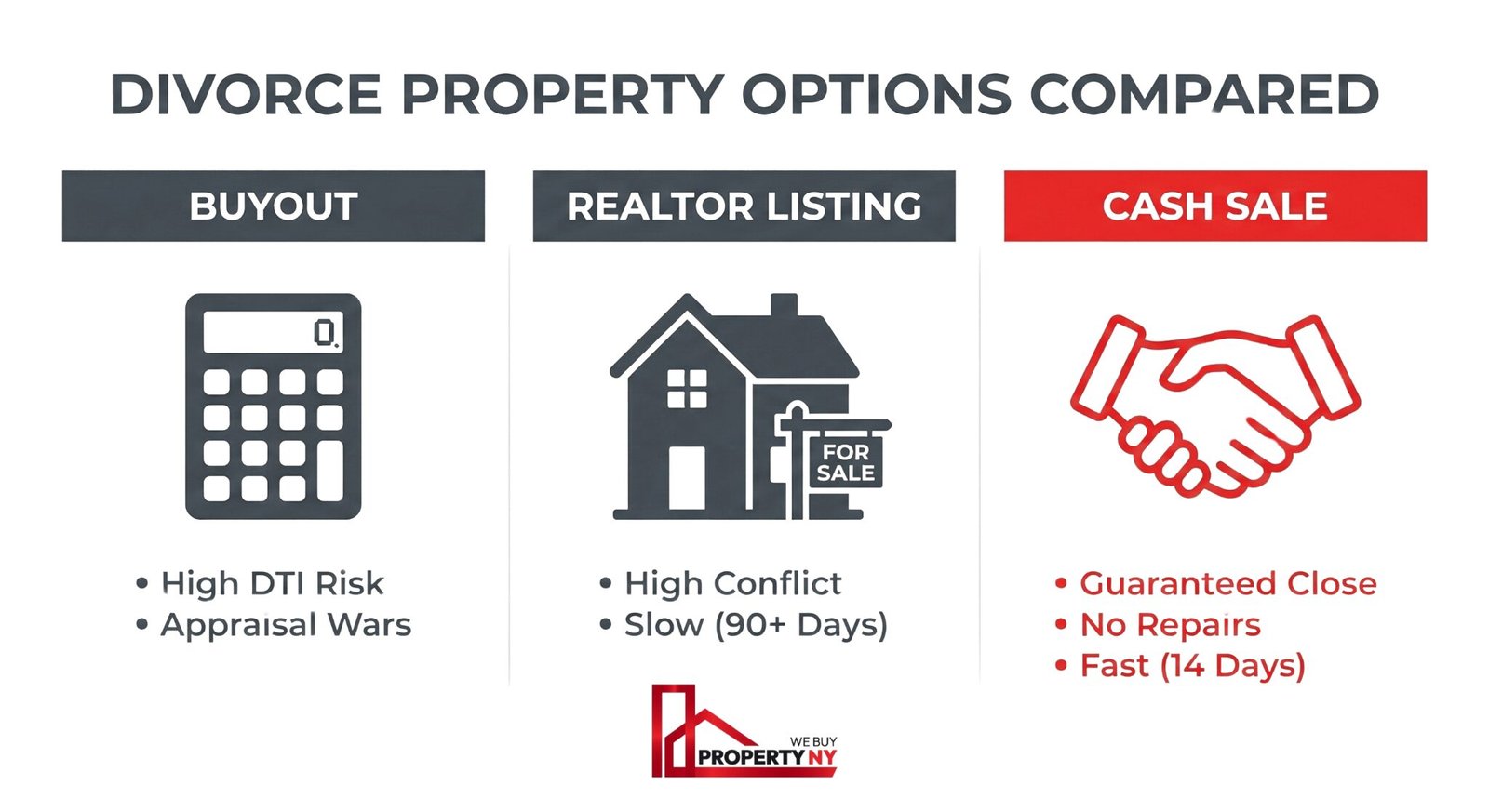
3 Ways to Sell During Divorce
Which Path Fits Your Situation?
| Comparison | 1. Buyout (Complex Path) | 2. Realtor Listing (High Conflict) | 3. Cash Buyer (Clean Break) |
|---|---|---|---|
| 💰 1. Financial Challenges | |||
| Costs & Risks | ❌ DTI shock: Single income ❌ Cash-out refinance needed ❌ Qualification failure risk Result: Hard to qualify | ❌ 5-6% Commission ❌ 2-4% Closing Costs ❌ Mortgage payments pile up Result: Proceeds shrink | ✅ Zero Commission ✅ Transparent closing costs ✅ Fast liquidity for both Result: Maximize Net Cash |
| ⚖️ 2. Legal & Conflict Issues | |||
| Disputes | ❌ Appraisal wars ❌ Deed transfer issues ❌ Tax basis complications Result: Judge decides | ❌ Fights over repairs ❌ Mediator often required ❌ Attorneys bill for delays Result: High Conflict | ✅ Minimal attorney work ✅ No repair disputes ✅ Court approval simplified Result: Low Conflict |
| ⏰ 3. Timeline & Certainty | |||
| Speed | ❌ Weeks of paperwork ❌ Financing may collapse ❌ Maintenance complications Result: High Failure Rate | ❌ 3+ Months typical ❌ Buyer financing risk ❌ Open houses required Result: Slow & Uncertain | ✅ 14 Days Guaranteed ✅ No bank delays ✅ Private & Discreet Result: Fast & Certain |
Summary Conclusion
Best for Fast Divorce Sales:
Conclusion: Choosing Your Fastest Path Forward
Divorce is difficult enough without a drawn-out property sale. To satisfy New York’s Equitable Distribution rules and move on, you need a path defined by clarity and speed, not ongoing negotiation.
A fast cash sale with WeBuyPropertyNY is often the simplest way to close this chapter. It allows both spouses to receive their designated share quickly, while avoiding repairs, commissions, and months of tension. Our team’s focus on equitable distribution sales ensures we provide a clean, fair exit in weeks, not seasons.
Are you ready to start?
Secure a fair, fast cash offer and finalize your equitable distribution.