
Key Takeaways
- The price cut on an as-is sale is only one part of the story. What matters most is how much cash you actually keep after repairs, fees, and months of holding costs.
- A house sold as-is may come in lower on paper, but skipping repairs, commissions, and delays can sometimes leave you with equal or even better net proceeds.
- Major repairs like roofing, HVAC, kitchens, bathrooms, and code fixes can wipe out the extra price sellers hope to gain from a traditional listing.
- Time has a real cost. Mortgage payments, taxes, insurance, utilities, and stress can keep draining money while you wait for repairs and a buyer.
- The best way to judge an as-is offer is to compare net proceeds, timeline, and risk instead of focusing only on the highest possible list price.
- as-is sales often make the most sense for inherited homes, distressed properties, tired rentals, relocations, and situations where speed matters more than perfection.

Introduction
One of the biggest fears sellers have is simple: Am I leaving money on the table? That question gets even louder when the house needs work, the roof is old, the kitchen looks dated, or there are bigger problems hiding behind the walls. If you have ever asked how much do you lose selling house as-is, you are asking the right question, but many sellers are still looking at the wrong number. The sale price alone does not tell the full story.
The real answer comes down to net proceeds, time, risk, and what you avoid paying out of pocket. The National Association of Realtors notes that remodeling payback varies widely by project, and points out that seller costs like commissions and closing expenses can take a real bite out of what you keep. That means a higher sale price does not always mean a better outcome. In this guide, we will break down the real numbers so you can see when selling as-is costs you money, when it saves you money, and when it can actually be the smarter move. Read on and do the math before you make a decision.
The Direct Answer: Typical as-is Discount
Let’s get straight to it. In many markets, an as-is home sells below what that same property might bring if it were fully repaired, cleaned up, and marketed in top condition. A practical working range many sellers use is about 10 percent to 30 percent below fixed up retail value, but the real gap depends on the house, the location, and how much uncertainty the buyer is taking on. Bankrate notes that as-is homes do tend to be priced lower because buyers know they may have to take on repairs and renovations, and research on distressed property sales has long found price discounts tied to condition and distress.
So if a fully updated home could sell for $300,000, the as-is range might land somewhere around $210,000 to $270,000. That is the number people see and panic over. But that panic usually starts because they are comparing the as-is offer to a fantasy number instead of a real net number.
This is why the phrase how much do you lose selling house as-is can be misleading. You are not comparing an as-is offer to some magical full retail check that lands in your pocket untouched. You are comparing one real path with another real path. One path includes repairs, delay, carrying costs, agent fees, inspections, buyer negotiations, and deal risk. The other path usually trades price for speed, certainty, and simplicity.
A few things affect the discount more than anything else:
- Severity of repairs
• Local market conditions
• Whether your likely buyer is a retail buyer or an investor
• How fast you need to sell
• Whether the house has financeability issues
• Whether the problems are cosmetic or structural
A house with old paint and worn carpet may see a smaller discount. A house with foundation movement, mold, plumbing failure, or code issues may see a much steeper one. That is why no serious seller should ask only what the house is worth fixed up. You also need to ask what it is worth right now, in its real condition, to the real buyers who will actually show up.
What You SAVE Selling as-is
Before you assume the lower offer means a worse deal, step back and look at what an as-is sale can remove from your budget. That missing expense list is often the reason the final result is much closer than sellers expect.
Repair and Renovation Costs
This is usually the biggest savings bucket. A home that needs work can easily eat through $15,000 to $50,000 or more, especially when several problems stack together. Even basic remodel cost guides show how quickly bathrooms, kitchens, roofing, and system replacements can climb, and NAR’s remodeling research also shows that sellers should not assume every dollar spent comes back at resale.
Think about what often shows up on repair lists:
- Roof replacement
• HVAC replacement
• Electrical updates
• Plumbing repairs
• Kitchen refresh or full remodel
• Bathroom repairs
• Flooring and paint
• Window replacement
• Water damage repairs
• Code violation correction
A seller may look at a house and think, “It only needs a little work.” But buyers, inspectors, and contractors often see a much larger bill. One old leak can turn into drywall work, mold remediation, insulation damage, and a roofing fix all at once.
Carrying Costs During Repairs
Even if you have the cash to fix the property, you still have to carry it while the work is being done. That means the home keeps costing you money every month you wait.
Common carrying costs include:
- Mortgage payments
- Property taxes
- Insurance
- Utilities
- HOA fees
- Lawn care or snow removal
- Vacancy risk and security concerns
Let’s use a simple example. If your monthly carrying cost is $2,500 and the repair and listing process takes six months, that is $15,000 gone. If it takes eight months, that is $20,000 gone. If permits, contractor delays, or reinspection issues stretch the timeline, it can go even higher. That is why speed has value. Cash now is not the same as cash later, especially when the property keeps draining you while you wait.
Real Estate Agent Commissions
In a traditional listing, commissions are still one of the biggest selling costs many homeowners face. Agents often earn around 2.5 percent to 3 percent per side, which means a combined commission can still be a large number depending on the deal structure. On a $300,000 sale, that can mean roughly $15,000 to $18,000.
Many direct cash buyers do not charge commission because they are buying the property themselves. That does not automatically make their offer better, but it absolutely changes the math.
Closing Costs and Fees
Traditional sales often come with title related fees, transfer taxes, recording costs, attorney fees in some states, and repair credits negotiated after inspection. Seller closing costs vary by state and deal structure, but they are real and they reduce what you keep. Sellers may face legal, title, and transaction related costs depending on the property and location. Some cash buyers offer to cover part or all of these costs. Not all do, so read the contract carefully, but when they do, that can narrow the gap more than sellers expect.
Staging and Marketing Costs
These are smaller than repairs, but they still add up. A seller trying to get top market price may spend money on cleaning, junk removal, landscaping, staging, photography, storage, and touch up work before the home ever hits the market.
Typical planning numbers might include:
- Professional staging: $2,000 to $5,000
- Photography: $300 to $500
- Light prep for showings: $1,000 to $3,000
- Deep cleaning and haul away: several hundred dollars more
None of these costs are outrageous alone. Together, they become another chunk of money that an as-is seller may never need to spend.

Real World Cost Comparison
The easiest way to understand this is to put both paths side by side. The numbers below are simple planning examples, not universal market averages, but they show exactly why net proceeds matter more than list price. When sellers ask how much do you lose selling house as-is, this is the comparison they should really be making.
Scenario 1: Traditional Sale After Repairs
Let’s say the home could sell for $300,000 after being fixed and properly listed.
Start with the expected retail sale price:
$300,000
Subtract repairs:
$25,000
Subtract carrying costs over 8 months:
$20,000
Subtract commission at 6 percent:
$18,000
Subtract seller closing costs at 2 percent:
$6,000
Estimated net proceeds:
$231,000
Estimated timeline:
8 to 12 months
At first glance, $300,000 sounds fantastic. But the seller does not walk away with $300,000. They walk away with something much lower, and that assumes repairs stay on budget and the home sells smoothly after the work is finished.
Scenario 2: Sell as-is to a Cash Buyer
Now let’s look at the same property sold as-is.
as-is offer:
$240,000
Repairs:
$0
Carrying costs:
$0 beyond the short closing window
Commission:
$0
Closing costs:
$0 if the buyer covers them
Estimated net proceeds:
$240,000
Estimated timeline:
7 to 14 days
This seller accepted a lower gross price but kept more money in the end.
The Real Math
In this example, the as-is sale actually puts $9,000 more in the seller’s pocket.
That is why the phrase how much do you lose selling house as-is often creates the wrong emotional reaction. Sellers see the lower offer and assume it must be the worse deal. But when you compare what actually reaches your bank account, the picture can flip fast.
And money is not the only factor. The as-is path also avoided:
- Eight to twelve months of waiting
- Contractor problems
- Surprise repair bills
- Reinspection headaches
- Buyer renegotiation after inspection
- Risk of a financed buyer falling through
When You Might Really Lose Money
There are also situations where selling as-is may leave money on the table. You may do better with a traditional sale if:
- The house only needs very minor work
- The repairs are mostly cosmetic
- You already have cash available
- You are not under time pressure
- The market is very strong
- Retail buyers are actively competing
If the home needs less than $5,000 in work and the issues are mostly visual, fixing it first may absolutely make sense. The smart move depends on the spread between the repaired net and the as-is net, not on the label attached to the sale.
Hidden Costs People Forget
This is the section many sellers skip, and it is where mistakes happen. The visible costs are easy to spot. The hidden costs are the ones that quietly eat your profit. If you are still wondering how much do you lose selling house as-is, remember that you can also lose money by trying to chase a higher price the wrong way.
Financing risk is a big one. A financed buyer can love your house, sign a contract, order inspections, negotiate credits, and still fail to close. Inspection issues, appraisal problems, loan conditions, or insurance issues can derail a deal. Then there is time value. Money now can be worth more than money later, especially if you need to pay off debt, stop a foreclosure, settle an estate, relocate, or free up cash for another home.
Stress and opportunity cost matter too. Your time has value. If you are spending months meeting contractors, checking work, cleaning for showings, and renegotiating with buyers, that is real life energy being spent. For some sellers, that cost is bigger than they expected. There is also market risk. Prices do not always keep rising. If the market softens while you are repairing the house, the hoped for upside can shrink or disappear.
And then there are surprise repairs. A seller starts with a $10,000 estimate and ends at $25,000 because the contractor opens a wall and finds more damage. That happens all the time.
Who Benefits Most from as-is Sales?
Not every seller should go as-is, but some sellers benefit much more than others. If you inherited a property out of state, or one filled with old belongings and deferred maintenance, speed and simplicity may matter more than squeezing out every possible dollar. Executors often want clear resolution, not a part time rehab project.
That is why how much do you lose selling house as-is is often the wrong question for estate situations. A better question is, “What is the cleanest and safest way to convert this property into cash without dragging the process out?”
Sellers in financial hardship may also benefit. If someone is facing foreclosure pressure, divorce expenses, job loss, or growing debt, waiting six to ten months for the perfect buyer may not be realistic. A slightly lower offer can still be the best move if it stops larger financial damage.
Relocating sellers is another strong fit. If you have already moved, managing repairs from another city can be exhausting and expensive. The same goes for tired landlords with tenant occupied rentals and years of deferred maintenance.
Here are a few simple examples:
- An inherited house worth $325,000 fixed up needs $40,000 in work and would take months to clear out. A fast $255,000 to $265,000 as-is sale may be more attractive than chasing a higher number through a stressful probate timeline.
- A rental home worth $280,000 fixed up needs $30,000 in repairs, tenant turnover, flooring, paint, and appliance replacement. An as-is deal at $230,000 may beat a long vacancy and more cash out of pocket.
- A relocating family with a home worth $350,000 repaired might accept $295,000 as-is because they cannot supervise contractors while living in another state and paying for two households.
In all of these cases, convenience is not just emotional. It has financial value.
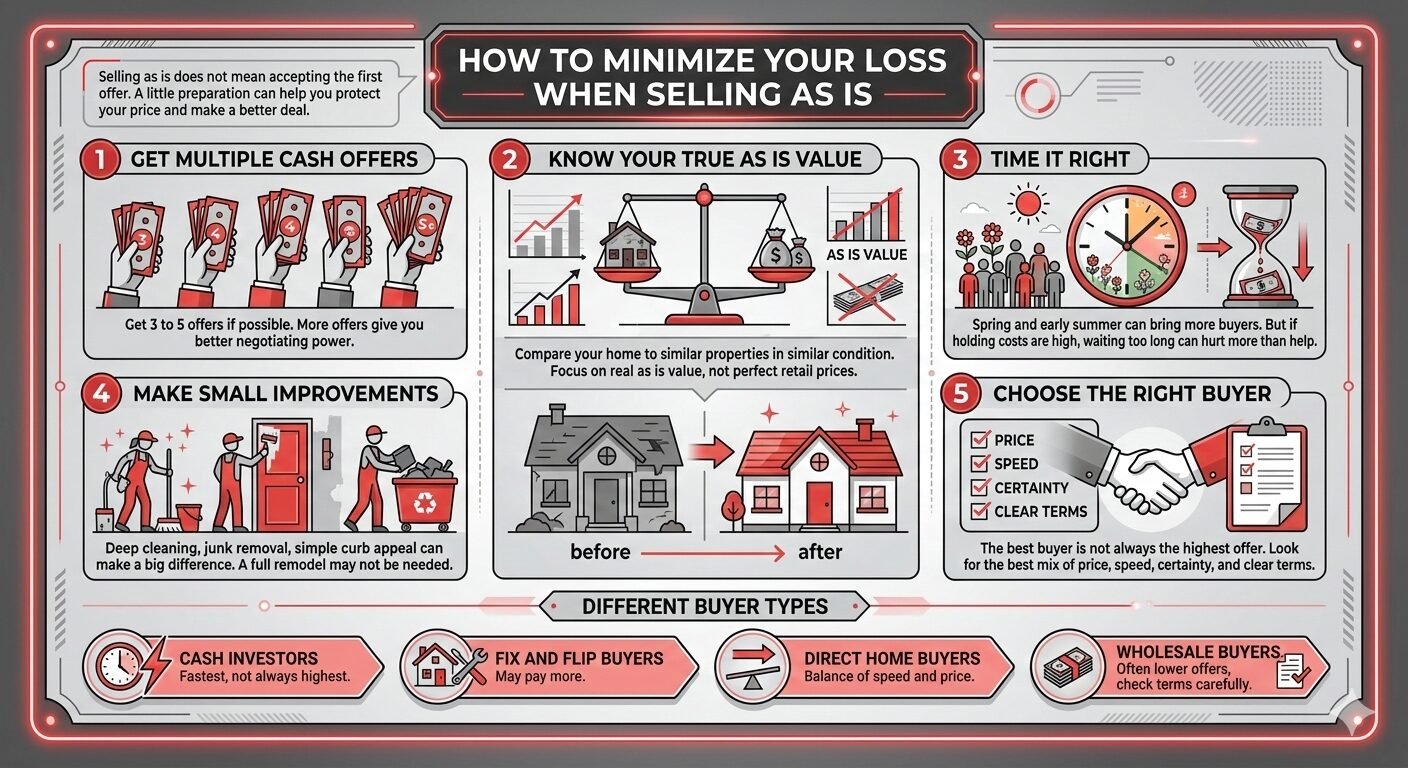
How to Minimize Your Loss When Selling as-is
If you decide to sell as-is, that does not mean you should accept the first number thrown at you. You can still protect yourself and improve the outcome.
The best answer to how much do you lose selling house as-is often comes from how well you prepare before choosing a buyer.
Get Multiple Cash Offers
Do not rely on one buyer. Get three to five offers if possible. Local buyers, regional buyers, and national buyers can price the same house very differently.
Competition creates leverage. Even if you prefer the fastest buyer, knowing what others will pay helps you negotiate with confidence.
Understand Your True as-is Value
Do not compare your house to perfect retail listings online. Compare it to homes with similar condition, similar repair needs, and similar buyer appeal.
You can do this through a real agent, an appraiser familiar with distressed property, or a local investor who shows their numbers clearly. The goal is to understand real as-is value, not dream value.
Time It Right
Even as-is homes benefit from better timing. Spring and early summer often bring more buyer activity. Holiday periods can be slower. If you have flexibility, timing can help.
That said, personal urgency matters more than season for many sellers. Waiting for the perfect month while carrying a costly house can backfire.
Do Strategic Mini Improvements
You do not always need a full remodel. Sometimes a deep clean, junk removal, fresh yard cleanup, and basic curb appeal are enough to improve buyer confidence.
Small planning numbers might look like this:
- Deep cleaning: $200 to $500
• Basic curb appeal: $500 to $1,000
• Trash out and simple organization: varies by property size
These are not major repairs. They just make the home easier to understand and less intimidating for buyers. In some cases, the return can be several times the cost.
Choose the Right Buyer Type
Not all buyers are the same, and the right buyer is not always the one with the highest offer. The best offer is usually the one that gives you the strongest mix of price, certainty, transparency, and closing speed. All cash investors are often the fastest option, but they do not always pay the most. Fix and flip buyers may offer a little more if they believe the home has strong resale potential after improvements. Some direct home buyers fall somewhere in the middle and can offer a fair balance between speed and price. Wholesale style buyers may come in with lower numbers and may try to assign the contract, so it is important to read the terms carefully and ask direct questions before agreeing to anything.
Red Flags: When as-is Might Be a Mistake
There are times when selling as-is is probably the wrong move. If you are asking how much do you lose selling house as-is, and your house only needs paint, carpet, and light cleanup, the answer may be: more than you need to.
Selling as-is may be a mistake when:
- The house only needs very minor cosmetic work
• You already have the cash to do simple updates
• You have time and patience
• The local market is extremely hot
• Buyers are already competing for homes like yours
• The property has no major system or structural issues
• You are not under any timeline pressure
In that kind of situation, basic prep may create more value than a fast discount sale.
Tax Implications and Legal Considerations
Selling as-is does not create a special tax rule. In general, the same capital gains rules apply whether you sell the house fixed up or as-is. The eligible sellers may be able to exclude up to $250,000 of gain from income, or up to $500,000 for certain married couples filing jointly, if they meet the ownership and use tests for a main home.
Legal disclosure still matters too. An as-is sale does not mean you can hide defects. National Association of REALTORS® says sellers generally still need to disclose known material defects, and federal law requires lead based paint disclosure for many homes built before 1978.
That means:
- as-is means you are not agreeing to make repairs
- It does not mean you can misrepresent condition
- State rules still apply
- Estate sales, trusts, liens, and title issues may need attorney review
This is one area where cheap advice can become expensive fast. If the house involves probate, inherited ownership, title problems, or unusual tax questions, talk to a qualified real estate attorney or tax professional before you sign anything.
FAQs
Q: Do I lose 50% selling as-is?
Usually, no. In most normal situations, a 50% haircut would suggest either extreme distress, a major title or legal problem, or a very low offer. For most ordinary properties, the real discount is far lower than that, and the net difference may be smaller once you subtract repairs and fees.
Q: Can I still negotiate as-is offers?
Yes. As-is does not mean non-negotiable. It simply means you are selling in current condition. You can still negotiate price, closing date, who pays costs, earnest money, and contract terms.
Q: What if I only fix some things?
That can be a smart middle ground. Clean the house, handle obvious safety issues, improve curb appeal, and skip the giant remodel. Many sellers get better results by doing the basics and avoiding over improvement.
Q: Do cash buyers lowball everyone?
Some do. Some do not. Serious buyers price based on repair cost, risk, resale value, and how fast they can close. The best protection is getting multiple offers and comparing the net, not just the headline number.
Q: How do I know if an offer is fair?
Ask yourself this: if I accept this number, how much cash do I keep, how fast do I close, and what risk am I avoiding? If you want the clearest answer to how much do you lose selling house as-is, compare the offer against your realistic repaired net, not against a perfect world retail number.
Conclusion
The biggest lesson here is simple: the “loss” from an as-is sale is often an illusion. Sellers focus on gross sale price because it is easy to see. But your real outcome depends on repairs, commissions, carrying costs, closing fees, time, and stress. In many situations, especially when the house needs serious work, the path can leave you surprisingly close to a traditional sale or even ahead of it.
So before you decide, run your own numbers. And if you want a fast side by side estimate, get a free as-is valuation and compare multiple offers with WeBuyPropertyNY so you can choose based on real net proceeds, not guesswork.
Meta Titles
- How Much Do You Lose Selling a House as-is? Full Math
- Real Numbers Behind Selling a House as-is for Cash
- What Do You Really Lose on an as-is Home Sale Deal?
- as-is House Sale Costs, Losses, and Savings Explained
- Selling a House as-is: What You Really Keep in Cash
Meta Descriptions
- See the real math behind selling a house as-is, including repair savings, holding costs, agent fees, and when an as-is sale can net you more money.
- Learn how much sellers really lose selling a house as-is and how skipped repairs, faster closings, and fewer fees can change the final outcome for them.
- Compare a repaired home sale with an as-is cash offer using real numbers, hidden costs, and simple examples that make the right choice much clearer.
- Find out when selling a house as-is saves money, when it does not, and how to compare offers based on net proceeds instead of list price alone first.
- Before fixing up your home, read this breakdown of as-is discounts, repair costs, commissions, and hidden savings that affect your bottom line most.